AS 4192 Arrow Boards Explained: What Traffic Controllers Need to Know Before Buying
Author: UAGS
AS 4192 is the Australian standard for illuminated flashing arrow signs. If you're buying an arrow board for a traffic control vehicle, here's what the standard covers, what the three size classes mean, what FAS/5 Type Approved status tells you, and why A
AS 4192 is the Australian standard that sets the performance requirements for illuminated flashing arrow signs used in temporary traffic management. If you're buying an arrow board for a traffic control vehicle, this is the standard your supplier should be referencing. Here's what it covers, what the size classes mean, and what to look for when you're choosing one.
In this guide
- What does AS 4192 actually cover?
- What are the three arrow board size classes?
- What does "tested against AS 4192" mean when buying?
- What is FAS/5 and does it matter outside NSW?
- Single-sided vs double-sided: which do you need?
- Why Australian-assembled matters for fleet operators
- Frequently asked questions
What does AS 4192 actually cover?
AS 4192 specifies the design, construction and performance requirements for illuminated flashing arrow signs. These are the vehicle-mounted or trailer-mounted boards you see at roadworks and lane closures, displaying left arrows, right arrows, double arrows and caution patterns to direct traffic around a work zone.
The standard covers photometric performance (how bright the sign must be in daylight and at night), colour accuracy (yellow light within defined CIE chromaticity limits), operating temperature range (-15 degrees C to 50 degrees C), enclosure protection (minimum IP45 for electrical components), fail-safe operation and automatic dimming via an integrated light sensor.
The current version is AS 4192:2022, which updated the earlier AS 4192:2006. Arrow boards tested against AS 4192-2006 remain in use and are accepted across the industry. When reviewing a supplier's compliance documentation, check which version was used and whether testing was carried out by a NATA-accredited laboratory.
What are the three arrow board size classes?
AS 4192 defines three size classes. The class you need depends on the road environment, approach speeds and your traffic management plan requirements. Always confirm the required class with your documentation and the road authority conditions for your project.
| Class | Display dimensions | Typical mounting | Typical use |
|---|---|---|---|
| A Class | 650 x 1260mm | Vehicle-mounted | Lower-speed roads, local streets, carparks |
| B Class | 770 x 1500mm | Vehicle-mounted | Highways, arterial roads, higher-speed environments |
| C Class | 1200 x 2400mm | Trailer-mounted | Freeways, major highways, high-speed or high-volume roads |
The B Class is the most common choice for traffic control utes in Australian temporary traffic management setups. It suits the majority of roadworks, lane closures and utility operations on arterial and highway environments. C Class trailer-mounted boards are used on freeway or major highway projects where visibility over longer distances is required.
What does "tested against AS 4192" mean when you're buying?
When a supplier states that a product has been tested against AS 4192, it means the arrow board has been assessed against the photometric, colorimetric, mechanical and electrical requirements in the standard. For that claim to carry weight, the testing should have been carried out by a NATA-accredited laboratory, with documentation available to support it.
This matters because not every arrow board on the market has been through independent testing. Some products use compliance language without documentation behind it. Before purchasing, ask for the test report reference and confirm which version of the standard was used.
The UAGS B Class arrow board has been tested against AS 4192-2006 by a NATA-accredited laboratory. Supporting documentation is available on request.
What is FAS/5 and does it matter outside NSW?
FAS/5 is the NSW Roads and Maritime Services (now Transport for NSW) technical specification for flashing arrow signs used on NSW roads. A product with FAS/5 Type Approved status has been assessed against that specification and accepted for use in NSW-regulated traffic management environments.
FAS/5 is a state-specific approval. It does not automatically apply in Victoria, Queensland, Western Australia or other states and territories. Each jurisdiction has its own road authority requirements, and project conditions will govern what equipment is acceptable on a given job.
If you're operating in NSW or running work under NSW road authority conditions, FAS/5 Type Approved status is a meaningful credential. If you're in another state, check your project documentation and road authority requirements directly.

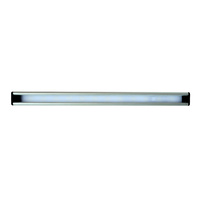
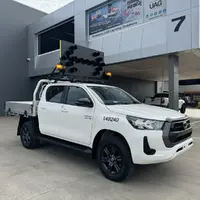
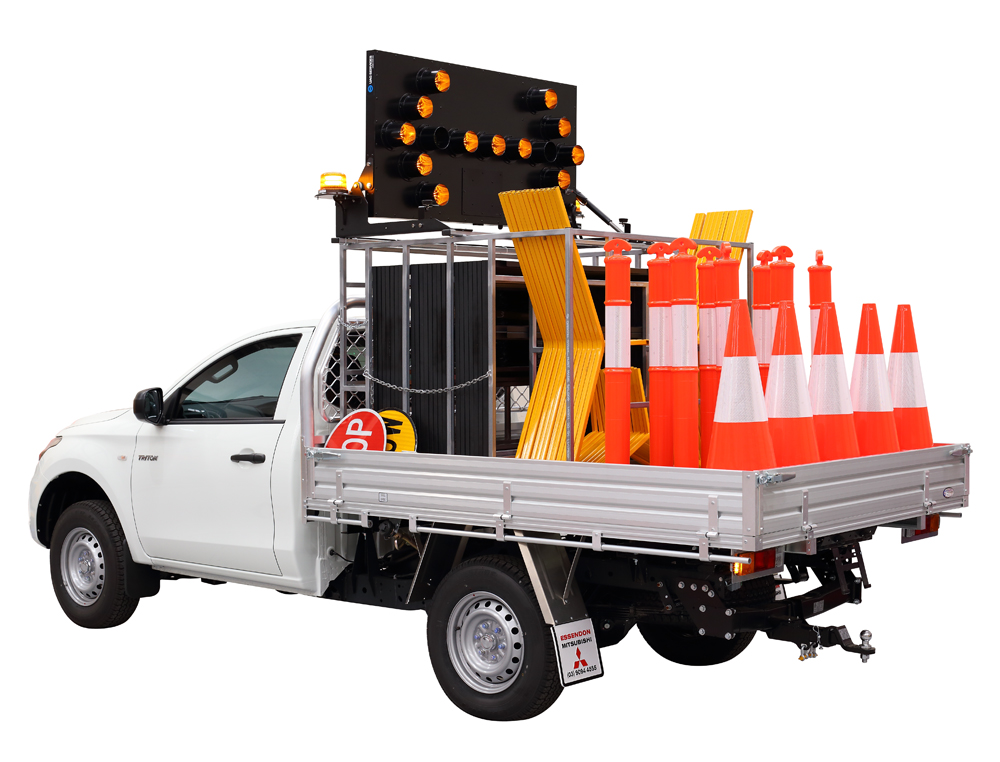
Vehicle-mounted B Class arrow board. Tested against AS 4192-2006 by a NATA-accredited laboratory. NSW RMS FAS/5 Type Approved. Assembled in Australia.
Single-sided vs double-sided: which do you need?
A single-sided arrow board displays to traffic approaching from one direction. This suits most standard traffic control ute setups where the board is rear-facing toward oncoming traffic.
A double-sided board displays on both faces, useful where the vehicle is positioned mid-block or where traffic approaches from both directions. Double-sided boards are heavier and draw more power, so your vehicle electrical system needs to be sized accordingly.
For most traffic control ute fitouts, a single-sided B Class board is the right starting point. If your operations regularly involve two-way working or specific setup requirements, confirm with your traffic management documentation whether a double-sided board is specified.

Double-sided B Class arrow board for two-way working and mid-block setups. Assembled in Australia.
Why Australian-assembled matters for fleet operators
The UAGS B Class arrow board is assembled in Australia using locally manufactured structural components, combined with imported electrical systems and actuator hardware. That distinction matters in a few practical ways.
Local assembly means the structural frame is built to suit Australian vehicle fitout standards and real working conditions. Serviceability is more straightforward when components can be sourced and assessed locally, rather than waiting on international supply chains. For fleet operators running multiple vehicles, the ability to get a warranty assessment or replacement part handled in Australia makes a real difference to uptime.
It also means the product has been put together and quality-checked in the same environment it will be used in, not shipped in a box from overseas and sold on spec.
.jpg)
Frequently asked questions
What is AS 4192?
AS 4192 is the Australian standard for illuminated flashing arrow signs used in temporary traffic management. It sets requirements for brightness, colour, construction, operating temperature range, enclosure protection and fail-safe operation. The current version is AS 4192:2022. The earlier AS 4192:2006 version is still in use across the industry.
Which arrow board class do I need for traffic control work?
The required class depends on the road environment and your traffic management plan. B Class (770 x 1500mm) suits most vehicle-mounted applications on arterial roads and highways. A Class suits lower-speed roads. C Class (trailer-mounted, 1200 x 2400mm) is used on freeways and major highways. Confirm the required class with your traffic management documentation and the applicable road authority conditions.
What does FAS/5 Type Approved mean?
FAS/5 is the NSW Roads and Maritime Services (Transport for NSW) specification for flashing arrow signs. FAS/5 Type Approved status means the product has been assessed against that specification and accepted for use in NSW-regulated traffic management environments. It is a state-specific approval, not a national one.
What comes with the UAGS B Class arrow board?
The board is supplied with mounting brackets, a 12V DC electric actuator (24V available on request), in-cabin controller with swivel mount, 4-core power cable, controller cable, Deutsch connector tails, dual MIDI fuse holder and MIDI fuses. Vehicle fitment, installation wiring beyond the supplied components and dual battery integration are not included and should be confirmed with your vehicle installer.
Is an arrow board enough on its own for a traffic control vehicle?
An arrow board is one component of a traffic control vehicle fitout. Most setups also include warning beacons or a light bar, a UHF radio, appropriate signage and a racking cage or storage system for site equipment. The full fitout should be confirmed against your traffic management requirements and applicable road authority conditions.
Can I use this arrow board in any Australian state?
Arrow boards need to meet the requirements of the relevant road authority where work is being carried out. FAS/5 Type Approved status is specific to NSW. If you're operating in another state or territory, check your project documentation and road authority conditions to confirm what is required.
Ready to spec up your traffic control vehicle?
The UAGS B Class arrow board is assembled in Australia, NATA-tested and FAS/5 Type Approved. In stock and available for dispatch.
View Arrow Board →Trade pricing available for traffic control companies. Contact us to discuss your requirements.